

From Shotgun to Strategy: How Elite Builders are Engineering 1-in-2 Win Rates in 2026
From Shotgun to Strategy: How Elite Builders are Engineering 1-in-2 Win Rates in 2026
The New Zealand construction sector is operating under some of the tightest economic conditions in fifteen years.
BWA Insolvency data shows corporate insolvency appointments hitting historic highs, tracking closely alongside post-GFC levels. With Auckland, Canterbury, and Wellington representing the vast majority of these distressed businesses, the Inland Revenue Department (IRD) has cracked down heavily on outstanding tax debt—which has surged globally toward the $10 billion mark. For residential builders, light commercial operators, and sub-contractors, relying on the "Bank of IRD" to fund day-to-day operations is no longer an option.
Yet, despite this intense margin compression, many Kiwi builders fall back on a flawed survival instinct when work slows down: the "shotgun approach." They quote every plan that comes across their desk, hoping that sheer volume will keep their crew busy.
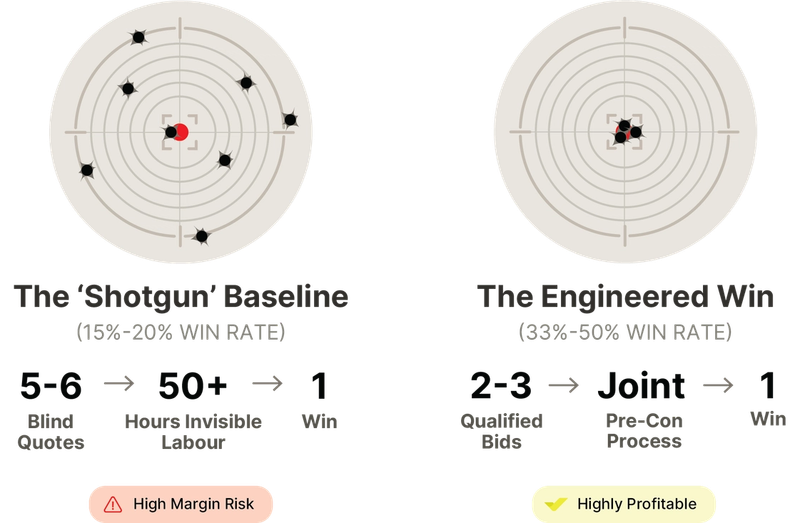
In construction circles, this performance is measured by your Bid-Hit Ratio (the number of jobs you price versus the number you actually secure). While an unvetted, reactive shotgun approach quickly drags contractors into a 6:1 or 7:1 ratio, the top-performing operators across New Zealand are refusing to accept those odds. They have abandoned the shotgun entirely to focus on a new discipline: strategically engineering a win.
The Invisible Drain on Kiwi Contractors
Every failed quote represents hours of invisible, uncompensated labour. In NZ's tight-knit residential and light commercial markets, compiling a proper estimate is highly demanding. When an owner-operator spends 10+ hours on a single comprehensive quote that only has a 15% to 20% chance of success, they are pouring dozens of hours of unbilled personal momentum into the void just to land a single project.
Think of it like running a hard set of hit-ups down at Go Media Stadium without a backline to back you up. You take the collision, you make the yards, but because there's no structure, clear communication, or delegation behind you, you turn the ball over anyway.
That is exactly what happens when an operator tries to run a manual, siloed pricing loop at the kitchen table after a long day on site:
- The Emotional Churn: If you don't vet a client for a strong emotional fit early in the piece, you end up pricing a job for a customer who will drain you dry before a shovel even hits the dirt. The hours spent on phone calls calming down an anxious, unvetted client who doesn't understand the realities of local building costs is time completely stolen from your business strategy.
- The Margin Leak: Rushing through a high volume of takeoffs while fatigued means missing critical scope gaps. In a market where supply chain ripples and material costs can fluctuate rapidly, an inaccurate bid can trap you in a fixed-price contract that erodes your profit margins before the slab is even poured.
- Site Disruptions: While you are stuck at the desk checking material prices, you aren't managing sub-trades effectively on site, leading to costly delays and sub-contractor disputes.
Shifting the Odds to 1-in-3
Elevating your business out of the danger zone and moving your metrics to a healthy 3:1 or 2:1 success rate doesn’t happen by dropping your margins to win cheap work. It is achieved by taking absolute ownership of the pre-construction process through a collaborative, team-based framework:
- Communication as a Competitive Edge: In New Zealand, trust is the ultimate business currency. When a builder can sit down with an end-client and present a highly structured, accurate, and transparent cost plan early on, the relationship transforms. You cease to be a transactional commodity competing on price, and instead become a trusted advisor mitigating their financial risk.
- The Builder-Estimator Connection: True precision comes from collaboration, not isolation. Top-tier operators don't guess their pricing or rely on rough square-metre rates. They delegate the technical takeoffs to specialist quantity surveyors. This effective connection allows the builder to "storytell" the project to the client with absolute confidence, matching the exact quality of the intended build to a realistic, bulletproof budget.
- Streamlining Supplier & Sub-Trade Networks: Working with a dedicated estimator ensures that sub-trade packages are cleanly defined. This clarity ripples out to your suppliers and sub-contractors, building stronger professional relationships because they know your projects are well-organised, accurately quantified, and ready to deploy without messy, unvetted variations.
"Better pre-construction processes don't just save time on each estimate. They increase volume, improve accuracy, and fundamentally shift the win rate—all simultaneously."
Taking Ownership of the Pipeline
Flipping your win rate to 33% or 50% fundamentally alters the trajectory of your business. It means you no longer have to chase five or six low-probability leads to keep your crew busy. Instead, your energy is focused on two or three highly targeted, collaborative, and accurately costed opportunities.
Pre-construction excellence is ultimately a shift in business maturity. It is a declaration that the health of a construction company is decided long before the framing goes up. For Kiwi builders looking to safeguard their cash flow, protect their margins, and build sustainable futures, escaping the shotgun trap is the first and most critical step.