

From Shotgun to Strategy: How Elite Builders are Engineering 1-in-2 Win Rates in 2026
From Shotgun to Strategy: How Elite Builders are Engineering 1-in-2 Win Rates in 2026
The modern Australian construction landscape is undergoing a quiet but aggressive operational shift. The old habit of treating quoting as a pure numbers game—firing out pricing and hoping for the best—is no longer just inefficient; it is actively pushing residential and light commercial operators out of the market.
According to recent ASIC insolvency figures, the construction sector continues to experience intense margin compression, routinely accounting for over 25% of all corporate failures nationally. With the Australian Taxation Office (ATO) fiercely pursuing collectible debt defaults exceeding $100,000, builders can no longer afford to waste their most valuable asset: time.
Yet, when lead volumes fluctuate, many operators fall back on a flawed survival instinct: the "shotgun approach." They quote every blueprint that drops into their inbox, mistakenly believing that a bigger pipeline equals a safer business.
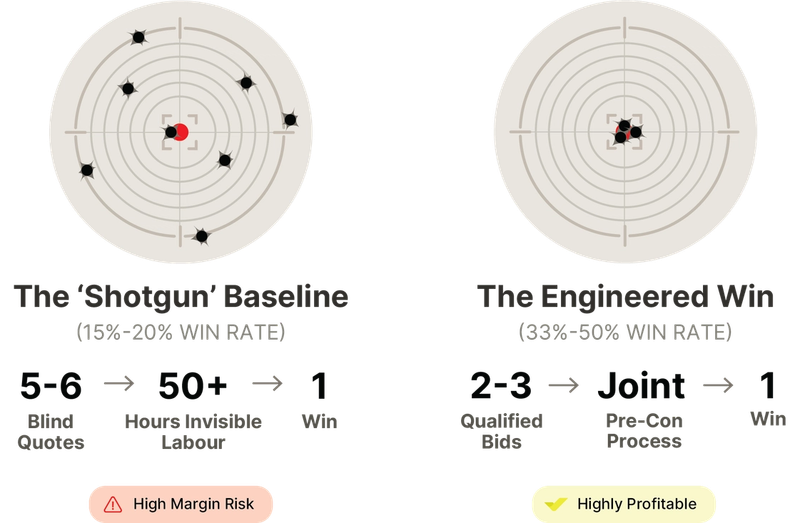
In construction circles, this efficiency is tracked by the Bid-Hit Ratio (the number of jobs you price versus the number you actually secure). While an unvetted, reactive shotgun approach quickly drags contractors into a 5:1 or 6:1 lag, the top-performing operators in Australia are refusing to accept those odds. They have abandoned the shotgun entirely to focus on a new discipline: strategically engineering a win.
The Heavy Toll of Invisible Labour
Every failed quote represents hours of invisible, uncompensated labour. For an owner-operator spending 10 or more hours on a comprehensive takeoff, material verification, and estimate, running a 5:1 hit rate means pouring up to 50 hours of unbilled personal momentum into the void just to land a single contract.
Imagine running a footy match where you try to play every single position yourself. You are the halfback trying to construct the play, the prop taking the hard hit-ups, and the referee trying to keep everyone honest. By the second half, you are completely gassed, dropping balls, and letting the opposition slide straight through the defensive line.
That is exactly what happens when an operator tries to run a manual, siloed pricing loop at the kitchen table after a 10-hour day on site:
- The Fatigue Deficit: Burned-out builders rushing through late-night takeoffs make critical errors. Missing a single structural scope gap can instantly wipe out the profit margin of the one job they do land.
- The Emotional Churn: When you don't vet a client for a strong "emotional fit" during pre-construction, you end up pricing for people who will spend the entire build texting you at 9:30 PM on a Sunday. The hours wasted trying to calm an anxious, unvetted client who doesn't understand construction realities is time completely stolen from your business strategy.
- Site Disruptions: Time spent guessing supplier numbers at a desk is time taken away from supervising active sites, managing subbies, and ensuring quality control.
Flipping the Odds: The Pre-Construction Excellence Framework
Elevating your business out of the shotgun trap and moving your metrics to a healthy 3:1 or 2:1 success rate doesn’t happen by dropping your margins to win cheap work. It is achieved by taking absolute ownership of the pre-construction process through a collaborative, team-based framework:
1. Ruthless Qualification over Volume
High-performing operators understand that not every lead is a good lead. By implementing strict "go/no-go" criteria based on client budget transparency, site alignment, and emotional fit, they weed out low-probability quotes early. They stop estimating for the sake of estimating.
2. Shifting from "Silo" to "Collaboration"
Exceptional builders treat pre-construction as a collaborative team sport. Think of your estimator as the elite hooker delivering a crisp, perfectly timed pass right into your hands. By connecting deeply with dedicated estimating specialists, the builder delegates the manual, technical mechanics of the takeoff. This frees up the cognitive headspace needed to step into their true strength: building client relationships and refining construction methodologies.
3. Communication and 'Storytelling' as a Competitive Edge
When a builder presents a highly accurate, transparent, and professionally structured cost plan, the client dynamic completely transforms. Because the builder understands the estimate inside and out through their close connection to the estimator, they can accurately "storytell" the project to the client. The conversation moves away from a transactional debate over the final number and becomes a collaborative partnership based on risk mitigation and value engineering.
"Better pre-construction processes don't just save time on each estimate. They increase volume, improve accuracy, and fundamentally shift the win rate—all simultaneously."
Business Maturity Means Better Backlogs
The math of changing your operational habits is undeniable. If you elevate your business out of the shotgun trap and move your win rate to 33% or higher, the dozens of hours of invisible labor previously scattered across five or six low-probability bids is compressed into a targeted, highly precise effort across two or three highly vetted projects.
Ultimately, pre-construction excellence is about business maturity. It is the realization that the health of an Australian building company isn't measured by how loud the hammers are on site, but by how clear, collaborative, and controlled the strategy is before the first payload of concrete arrives.
For the modern builder, the path to a sustainable backlog doesn't require working harder into the night. It requires changing the pre-construction game entirely.